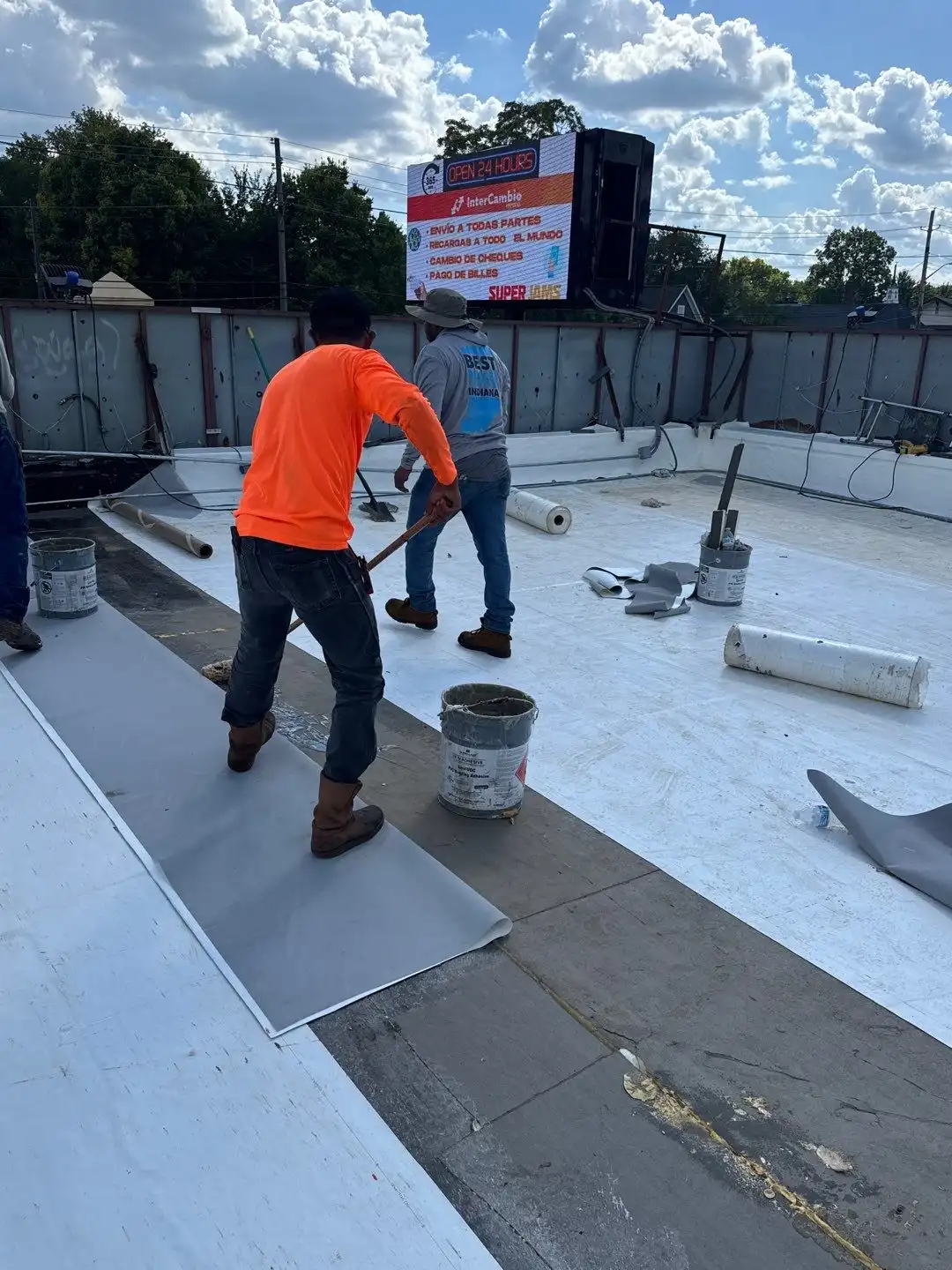
Match the membrane to the building
The cleanest way to choose between TPO, EPDM, and PVC is to start from the building rather than the brochure, because the type of Downtown Indianapolis building and how it is used narrows the field fast. Here is how the three line up against the building types most common across Marion County.
Warehouses and distribution
Large, simple roofs with few penetrations and a tight budget are where TPO shines. The reflective white surface helps with cooling a big interior volume, the welded seams hold up well, and the lower installed cost matters a lot when you are covering tens of thousands of square feet. EPDM is a reasonable alternative here too, especially if long track record outweighs the energy benefit. For most Downtown Indianapolis warehouses, the decision is TPO unless something specific argues otherwise.
Restaurants and food service
Any building with kitchen exhaust putting grease and oils onto the roof should look hard at PVC. Grease degrades TPO and EPDM over time, and a membrane that fails early around the exhaust fans is a false economy no matter how low the first cost was. PVC's resistance to grease and chemicals is exactly why it dominates this category. Spending more up front on PVC for a Downtown Indianapolis restaurant usually costs less over the life of the roof than replacing a cheaper membrane that the grease ate through.
Medical, lab, and process buildings
Buildings that vent chemicals or run rooftop equipment that discharges onto the membrane are PVC territory for the same reason as restaurants. The exposure rules the decision. Where the roof is clean and exposure is normal, TPO or EPDM can serve a medical office fine, but anywhere chemical discharge touches the roof, PVC earns its premium.
Offices and retail
General commercial buildings without unusual exposure have the most freedom, which means cost, energy goals, and hold horizon decide it. A Downtown Indianapolis office focused on cooling costs leans toward reflective TPO or PVC. One that values the longest proven track record and cold weather performance might choose EPDM. Retail centers often go TPO for the cost and energy balance. None of these is a wrong answer, so here the priorities you set are what break the tie.
When the building points two ways
Some buildings have mixed conditions, like a warehouse with a small commercial kitchen, where part of the roof sees grease and the rest does not. In those cases the exposure on the worst area usually drives the whole roof decision, because running two membranes adds complexity at the transition. A Marion County building with any meaningful chemical or grease exposure generally lands on PVC for the whole roof rather than mixing systems.
Mixed use and phased buildings
Some Downtown Indianapolis buildings combine uses under one roof, like a retail space with a small restaurant, or an office attached to a light industrial bay, which means different parts of the roof face different exposure. The cleanest approach is usually to choose the membrane that handles the most demanding area and run it across the whole roof, because mixing membranes adds complexity and a vulnerable transition between systems. If one corner of the building vents grease, that corner often dictates PVC for the entire roof. Phased buildings, where sections were added over time, also benefit from a single membrane choice at replacement, which simplifies future maintenance and warranty coverage rather than leaving a patchwork of systems and ages.
Schools, churches, and municipal buildings
Institutional buildings across Marion County add their own wrinkle to the membrane choice, usually around budget cycles and long ownership. These owners hold buildings for the very long term and often fund roofs through capital programs, which can favor a membrane with the longest proven life and the most predictable performance. EPDM's track record appeals here, while reflective TPO appeals where energy budgets are tight and the roof is large and simple. The deciding factor is often the same as anywhere else, exposure and use, but the long hold horizon makes the lifecycle comparison especially worth running, because a small per year difference compounds over the decades these owners keep a building.
Cold storage and temperature controlled buildings
Buildings that keep their interiors cold or tightly temperature controlled add a consideration that does not apply to a standard warehouse: the roof assembly has to manage a large temperature difference between inside and out without condensation problems. The membrane choice interacts with the insulation and vapor control in these Downtown Indianapolis buildings, and the priority shifts toward a system that handles thermal performance and moisture management well as a whole. Any of the three membranes can work on a cold storage building when the assembly is designed correctly, but the design of the full system matters more here than the membrane brand, and it is worth working with a roofer who understands the moisture dynamics of a temperature controlled building rather than treating it like an ordinary roof.
Buildings with heavy rooftop traffic are another special case. Where staff regularly walk the roof to service HVAC, refrigeration, or other equipment, the membrane takes wear along the traffic paths, and a thicker membrane plus walk pads protects those routes. This applies across all three membranes, since foot traffic wears any of them, but it changes the spec toward added thickness and protection in the high traffic areas. For a Marion County building with constant rooftop service activity, designing for that traffic from the start prevents the worn paths that otherwise become the first place the roof leaks.
The takeaway is that the membrane and the way it is installed work together, and judging one without the other leads to disappointment. A Downtown Indianapolis owner who compares only the membrane name misses that two roofs with the same membrane can last very different amounts of time depending on the substrate, the seam quality, and the detailing. Treat the proposal as a whole system, deck to details, and the comparison gets honest.
It also helps to think about the roof in the context of the whole building rather than as an isolated purchase. The membrane interacts with the insulation, the drainage, the rooftop equipment, and how the space below is used, and the best choice accounts for all of it. A Marion County owner who upgrades the insulation at replacement, corrects long standing drainage problems, and matches the membrane to the building's real exposure gets a roof that performs as a system, not just a new top layer over old problems. Treating a reroof as a chance to fix the whole assembly, while the old roof is off and the deck is visible, is how you get the full value from the project. The membrane gets the attention, but the system underneath is what carries it through twenty years of weather, and getting that right is what makes the membrane choice pay off.
The pattern across all of these is simple: exposure and use point to the membrane more reliably than price does. Clean, simple, cost driven roofs go TPO. Long track record and cold flex priorities go EPDM. Grease and chemical exposure go PVC. Downtown Indianapolis Commercial Roofing reads your building's exposure and use during a free Downtown Indianapolis inspection and recommends the membrane that fits it, not the one easiest to buy. Call (765) 676-3491 and get a recommendation matched to your building. That match is the difference between a smart spend and an expensive guess.